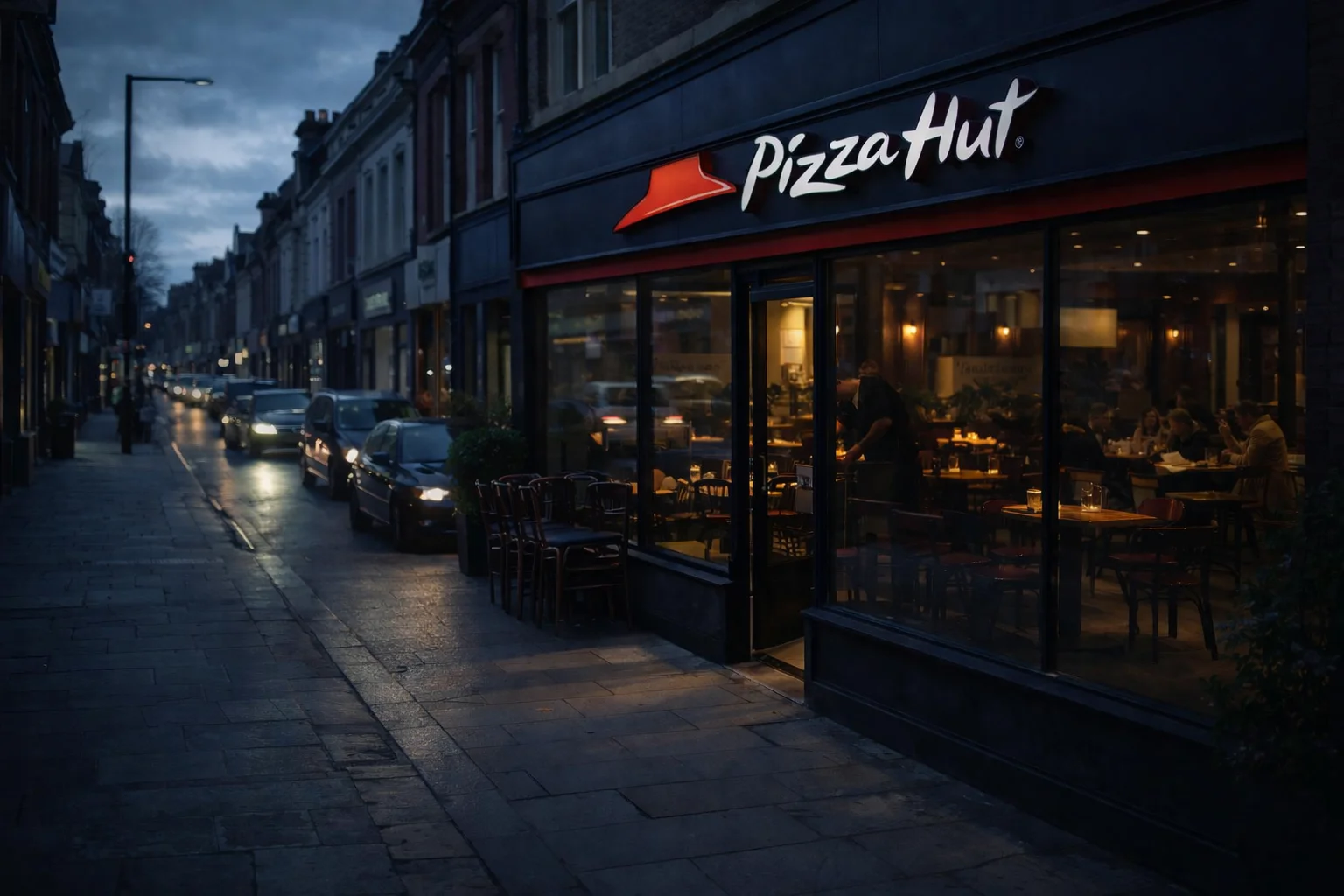
Pizza Hut is not going out of business globally. While recent headlines about store closures in the UK and the United States have raised concerns, the reality is more nuanced.
The brand is undergoing restructuring, closing underperforming locations, and shifting its focus towards delivery-driven formats rather than traditional dine-in restaurants.
Backed by Yum! Brands, Pizza Hut continues to operate thousands of outlets worldwide. The changes reflect adaptation to economic pressures, evolving consumer behaviour, and competitive market dynamics rather than a full-scale shutdown.
Key points covered in this article:
- Global operations remain active across 100-plus countries
- UK dine-in closures linked to franchise administration
- US closures target underperforming locations
- Shift from dine-in to delivery focused model
- Impact of rising costs and consumer trends
- Franchise structure protecting global stability
What Is Really Happening Behind Pizza Hut’s Recent Store Closures?
To understand the current situation properly, it is important to separate headlines from business fundamentals.
When people search is pizza hut going out of business, the concern usually comes from seeing multiple reports about closures in different countries. However, closures alone do not define a company’s overall health.
Pizza Hut operates primarily under a franchise system. This means that while the global brand is owned by Yum! Brands, many individual restaurants are managed by regional franchise operators.
If a franchise operator struggles financially, that issue may be localised rather than global.
Globally, Pizza Hut has close to 20,000 restaurants operating across more than 100 countries. That scale matters. A company with that footprint does not disappear overnight because of closures in specific regions.
Closures typically occur for several structured business reasons:
- Underperforming locations with sustained losses
- Shifts in customer demand away from certain formats
- Rising operational costs that reduce profitability
- Lease structures that are no longer commercially viable
In recent years, hospitality businesses across the UK and the US have faced increasing cost pressures. Energy bills, food inflation, and wage growth have significantly altered the cost base of running a dine-in restaurant.
To understand the broader restructuring trend, the following table outlines common triggers behind store closures in the restaurant sector.
| Business Trigger | Impact on Restaurant Performance | Typical Corporate Response |
| Rising rent and business rates | Reduced net profit margins | Lease renegotiation or closure |
| Labour cost increases | Higher operational expenditure | Automation or downsizing |
| Shift to delivery apps | Lower dine-in footfall | Format redesign |
| Inflation in the food supply | Increased menu pricing pressure | Menu restructuring |
| Competitive saturation | Decline in market share | Strategic consolidation |
Pizza Hut’s recent actions align with these standard corporate responses. This suggests operational recalibration rather than collapse.
Why Are Pizza Hut Restaurants Closing in the UK?
The UK situation gained attention when the dine-in franchise operator entered administration. Around 68 restaurants were affected, primarily those operating under the larger sit-down model.
Administration in the UK is a legal process designed to protect a business while restructuring debt and contractual obligations. It does not automatically mean liquidation.
The challenges faced by the UK dine-in segment were shaped by several external pressures:
- Reduced consumer spending due to the cost-of-living crisis
- Decline in shopping centre footfall
- Increased wage costs
- High commercial property rents
Delivery and takeaway locations were less affected because their cost structure is different.
What Happened to the UK Dine In Franchise Operator?
The franchise operator managing the dine-in estate faced sustained financial pressure. Administration allowed an orderly restructuring process.
Some sites closed permanently, while others were acquired by Yum! Brands to preserve operations.
This shows continued belief in the UK market from the global parent company.
The structural difference between dine-in and delivery operations in the UK can be illustrated below.
| Feature | Dine In Model | Delivery Focused Model |
| Premises size | Large high street units | Smaller units or industrial estates |
| Staffing levels | Front of house and kitchen teams | Primarily kitchen and dispatch |
| Overheads | Higher rent and utilities | Lower fixed costs |
| Revenue dependency | Walk-in customers | App and online orders |
| Flexibility | Limited | High scalability |
As a professional analysing hospitality trends, I would say clearly, “This is not a sign of a dying brand but a reflection of a format under pressure.” The casual dining model in the UK has struggled across multiple chains, not just Pizza Hut.
How Has This Changed Pizza Hut’s Presence on the High Street?
The high street presence is now more concentrated. There are fewer large family-style restaurants and a greater emphasis on streamlined operations.
This aligns with broader retail evolution in the UK. Brands are focusing on:
- Lower overhead structures
- Delivery partnerships
- Data-driven marketing
- Digital ordering platforms
The visible footprint may appear smaller, but operational efficiency can improve overall performance.
Why Is Pizza Hut Shutting Underperforming Locations in the United States?
In the United States, Yum! Brands announced plans to close approximately 250 underperforming Pizza Hut locations during the first half of 2026. While that figure may seem large, it represents a small percentage of the total global estate.
Corporate reviews often involve portfolio optimisation. Underperforming stores are evaluated against profitability benchmarks.
Common performance indicators include:
- Same store sales growth
- Operating margin
- Labour cost ratios
- Local competition density
The objective is to redirect resources toward high-performing markets.
The following table outlines how corporate restaurant chains typically evaluate store performance.
| Metric | Healthy Location Benchmark | Underperforming Indicator |
| Annual revenue growth | Positive year-on-year | Consistent decline |
| Labour cost ratio | Within industry norm | Exceeds benchmark |
| Rent-to-revenue ratio | Sustainable percentage | Disproportionately high |
| Delivery penetration | Growing share | Stagnant or declining |
| Customer retention | Stable repeat orders | Declining loyalty |
From a strategic standpoint, closing weak locations can strengthen the overall brand. “In corporate restructuring, removing loss-making units protects long term viability,” I would explain when assessing such moves professionally.
Competition in the US pizza market is intense. Domino’s and other delivery-first competitors have invested heavily in digital platforms and logistics. Pizza Hut is repositioning itself to compete more effectively.
How Is the Casual Dining Crisis Affecting Big Restaurant Chains?

The casual dining sector in both the UK and the US has faced structural change over the past decade.
Key economic and behavioural shifts include:
- Increased preference for convenience
- Growth of app-based ordering
- Reduced family dine-out frequency
- Higher raw material costs
These factors have reshaped revenue models.
The following table compares historical dine-in dominance with modern delivery-driven growth.
| Industry Era | Primary Revenue Driver | Consumer Behaviour | Risk Exposure |
| Early 2000s | Family dine in | Weekend outings | High fixed costs |
| Post 2015 | Delivery growth | Convenience focused | Platform dependency |
| Post pandemic | Digital ordering | Remote consumption | Logistics complexity |
Hospitality chains that adapted early to delivery infrastructure generally weathered the transition more effectively.
Pizza Hut historically invested heavily in large-format restaurants. While those locations built a strong brand identity, they also created long-term lease commitments.
Another relevant financial comparison illustrates cost exposure differences.
| Cost Category | Large Dine In | Compact Delivery Unit |
| Rent | High | Moderate |
| Utilities | High | Lower |
| Staffing | Extensive | Lean |
| Maintenance | Significant | Limited |
| Break-even threshold | Higher revenue needed | Lower revenue needed |
These structural realities explain why many large restaurant chains have reduced physical dining estates.
Is Pizza Hut Financially Struggling Compared to Competitors?
When evaluating whether Pizza Hut is facing severe financial distress, it is important to compare performance within Yum! Brands and against competitors.
Yum! Brands owns KFC, Taco Bell, and Pizza Hut. Recent financial disclosures indicate stronger growth from KFC and Taco Bell compared to Pizza Hut. However, slower growth does not equate to insolvency.
Brand repositioning often follows comparative performance analysis.
Competitive positioning in the UK market can be summarised as follows:
| Brand | Core Strength | Business Model Focus | Market Perception |
| Domino’s | Delivery efficiency | Delivery first | Tech driven |
| Pizza Hut | Brand heritage | Mixed dine-in and delivery | Transitioning |
| Independent chains | Local appeal | Flexible formats | Community focused |
Pizza Hut’s mixed model has required recalibration. Transitioning from legacy formats to modern operational structures takes time.
As a business observer, I would say, “Transformation is often mistaken for decline. In reality, strategic restructuring can be a sign of long-term resilience.”
Investor confidence in Yum! Brands remain stable overall. The group continues to report global revenues across its portfolio, indicating financial backing behind strategic decisions.
What Does This Mean for Pizza Hut’s Future in the UK?

The future trajectory in the UK appears to involve optimisation rather than exit.
Likely developments include:
- Continued emphasis on delivery led units
- Smaller footprint stores
- Investment in online platforms
- Selective retention of profitable dine-in sites
Consumer demand for pizza remains strong. The product itself is not declining in popularity. What is evolving is the format of consumption.
Technology integration will likely play a larger role in growth. Data analytics, targeted promotions, and streamlined supply chains are becoming central to profitability.
Long-term sustainability depends on:
- Lease renegotiation flexibility
- Labour efficiency
- Brand repositioning
- Digital competitiveness
The UK market remains commercially attractive. A leaner estate with stronger unit economics can produce healthier long-term results.
How Is the Franchise Model Influencing Pizza Hut’s Stability?
One of the most important factors in understanding Pizza Hut’s current position is its franchise structure. Unlike a fully corporate-owned chain, Pizza Hut operates through a network of independent franchisees who run restaurants under licence from Yum! Brands.
This model offers expansion advantages but also introduces variability in performance.
Under the franchise system:
- Franchisees are responsible for day to day operations
- Local operators manage staffing and lease agreements
- Profitability can vary by region
- The corporate headquarters provides branding, systems, and strategic direction
If a franchisee encounters financial distress, that issue may affect dozens of restaurants locally without signalling weakness at the global level.
The structure can be better understood in the following breakdown.
| Franchise Element | Responsibility of Franchisee | Responsibility of Yum! Brands |
| Daily operations | Yes | No |
| Staffing decisions | Yes | No |
| Rent and lease contracts | Yes | No |
| Brand standards | Must follow | Sets requirements |
| Marketing strategy | Local execution | National campaigns |
| Technology systems | Implement | Develop and maintain |
This separation explains why administration in one region does not automatically indicate global instability.
Franchise models can also protect parent companies during downturns. Risk is distributed across operators rather than centralised. However, the downside is inconsistency in operational performance.
From a professional standpoint, I would say, “The franchise structure cushions global brands during local turbulence. It allows corporate leadership to intervene selectively without absorbing every regional shock directly.”
In the UK example, Yum! Brands stepping in to acquire certain sites demonstrates active management rather than abandonment. It shows that the global parent is willing to restructure when necessary to maintain brand continuity.
Another key element influencing franchise stability is contractual flexibility. Long-term leases signed during stronger economic periods can become burdensome during downturns. Franchise operators may struggle if revenue projections no longer align with fixed costs.
A simplified financial exposure comparison illustrates this dynamic.
| Financial Exposure Type | Corporate Owned Model | Franchise Model |
| Centralised rent risk | High | Lower |
| Local operator risk | Limited | High |
| Corporate debt burden | Higher | Distributed |
| Operational control | Direct | Indirect |
The distributed risk nature of franchising partially explains why Pizza Hut as a global brand remains operational even when regional operators face insolvency.
This context is crucial when evaluating claims that Pizza Hut is going out of business. A franchise restructuring in one territory does not equal a global collapse.
What Role Does Consumer Behaviour Play in Pizza Hut’s Reinvention?

Another critical factor shaping Pizza Hut’s restructuring is consumer behaviour. Over the past decade, eating habits in both the UK and the United States have evolved significantly.
Several long-term shifts have influenced restaurant performance:
- Increased reliance on food delivery apps
- Greater demand for convenience
- Reduced the frequency of large family dining out occasions
- Heightened price sensitivity during economic uncertainty
Pizza Hut originally built much of its brand identity around family-friendly dine-in experiences. Buffet-style offerings and large restaurant formats were central to that strategy. However, modern consumers increasingly prioritise speed and accessibility over extended in-restaurant dining.
The behavioural shift can be mapped across time.
| Period | Dominant Consumer Preference | Impact on Pizza Chains |
| 1990s and early 2000s | Family dining experiences | Growth of large-format restaurants |
| 2010 to 2019 | Online ordering growth | Increased delivery investment |
| Post 2020 | Home consumption and app usage | Acceleration of digital transformation |
Digital platforms have fundamentally altered competitive dynamics. Domino’s invested heavily in app technology and delivery logistics early on. Pizza Hut has since increased its digital focus, but the transition from legacy infrastructure takes time.
Price sensitivity has also intensified. During periods of inflation and cost-of-living pressure, consumers often trade down or reduce discretionary spending. Restaurants must balance menu pricing with perceived value.
Operational agility becomes essential under these conditions.
As a business observer, I would explain, “Consumer expectations now revolve around speed, convenience, and value. Brands that adjust to those expectations remain relevant. Those that cling to outdated formats struggle.”
The reinvention process involves aligning operations with these behavioural realities. Smaller store footprints, improved digital interfaces, and optimised delivery networks reflect adaptation to market demand rather than retreat.
Brand resilience often depends on its ability to evolve with customer behaviour. Pizza Hut’s current changes suggest strategic repositioning in response to these broader consumption patterns.
Understanding this behavioural context is essential before concluding whether the brand faces existential risk. The evidence points more toward a transformation shaped by consumer trends than systemic failure.
Conclusion
So, is Pizza Hut going out of business? Based on the operational data, franchise restructuring, and global footprint, the answer remains no. While closures in the UK and the United States reflect economic pressure and strategic consolidation, the brand continues to operate thousands of restaurants worldwide.
What we are witnessing is not collapse but recalibration. In a rapidly evolving hospitality landscape, Pizza Hut appears to be adapting its model to remain competitive, efficient, and relevant for the long term.
FAQs
Are all Pizza Hut restaurants closing in the UK?
No. Only certain dine-in locations were affected by administrative proceedings. Many delivery and takeaway branches continue to operate across the UK.
Who owns Pizza Hut in the UK?
Pizza Hut operates under franchise agreements, with the global brand owned by Yum! Brands. Different franchise operators manage specific restaurant formats.
Is Pizza Hut filing for bankruptcy worldwide?
There is no global bankruptcy filing. Some franchise operators have entered administration, but the international brand remains active.
How many Pizza Hut locations exist globally?
Pizza Hut operates approximately 20,000 restaurants worldwide across more than 100 countries.
Why are dine-in restaurants struggling more than delivery outlets?
Dine-in locations face higher rent, staffing, and energy costs, while consumer behaviour increasingly favours convenience and home delivery.
Is Pizza Hut less profitable than Domino’s in the UK?
Domino’s has benefited from a delivery-focused model for years. Pizza Hut has been adjusting its structure to compete more effectively in that space.
Could more Pizza Hut stores close in the future?
It is possible that additional underperforming locations may close as part of ongoing strategic reviews, but this does not indicate a full shutdown of the brand.