
Travel Insurance & War: 2026 UK Guide
Insurance Protocol • Updated March 10, 2026
The 2026 “Known Event” Rule: As of March, conflicts in the Middle East and surrounding airspace closures are classified as “Known Events.” Policies purchased after hostilities began will likely exclude all related claims.
Standard Policies
Typically includes a “War Exclusion Clause.” Claims for cancellation, delay, or medical care due to active hostilities are generally denied.
CFAR Upgrades
“Cancel For Any Reason” allows for 50-75% reimbursement, provided the trip is cancelled 48-72 hours before departure.
Critical Warning: Travelling against FCDO advice (to “Red” or “Amber” regions) typically invalidates your entire policy, including cover for non-war medical emergencies or lost luggage.
Global events can influence travel plans in ways that few travellers anticipate when booking a holiday or business trip. In recent years, geopolitical tensions and armed conflicts have disrupted flights, closed borders, and created uncertainty for travellers worldwide. As a result, many people are asking a critical question: Does travel insurance cover war?
For UK travellers, the answer is not always straightforward. Most travel insurance policies include specific exclusions related to war or military conflict. However, coverage can depend on several factors, including when the trip was booked, whether government travel advice has changed, and how insurers classify the event causing disruption.
Understanding these distinctions can make a significant difference when planning travel during uncertain times. Many travellers assume that insurance will cover all disruptions, but the terms of a policy may tell a different story.
A commonly repeated piece of advice from travel risk specialists summarises the situation well:
“Travel insurance is designed to protect travellers from personal risks, not global conflicts. When war enters the picture, the rules change.”
This article explains how war affects travel insurance coverage, what UK travellers should know about policy exclusions, and how travellers can make more informed decisions when geopolitical tensions affect travel plans.
This is a critical addition for 2026. In the current insurance landscape, the “Known Event” rule is the #1 reason claims are being rejected for trips to the Middle East or surrounding regions.
The “Known Event” Cut-off: Why Timing is Everything in 2026
As of March 2026, the ongoing conflict in the Middle East, specifically involving Israel, Iran, and regional airspace closures, has officially been classified as a “known event” by nearly all UK travel insurers.
This classification changes the rules of coverage instantly. Insurance is designed to protect you against the unforeseeable.” Once a conflict becomes a matter of public record and is widely reported in the news, it is no longer considered a “random” or “unforeseeable” risk.
How the “Known Event” Rule Impacts You:
- The Purchase Date Deadline: If you purchased your policy after the conflict escalated (roughly late February 2026), your insurer will likely exclude any claims related to that specific unrest.
- No “Cancellation” for Known Risks: You cannot buy a policy today to cover a trip you want to cancel tomorrow because of the war. To the insurer, this is like buying fire insurance while your house is already on fire.
- Airspace Disruptions: Because the current Middle East situation has led to widespread 2026 airspace closures, even if your destination is technically “safe,” a flight cancellation due to rerouting may be excluded if you bought your policy after the disruptions began.
Does Travel Insurance Cover War or Military Conflict?

In most standard policies, travel insurance does not cover losses directly caused by war or military conflict. This limitation exists because war introduces large-scale uncertainty that insurers cannot reliably assess.
Insurance companies operate by calculating predictable risks. Events such as illness, lost luggage, or delayed flights occur frequently but affect individuals rather than entire travel systems. War, on the other hand, can simultaneously disrupt airlines, airports, governments, and infrastructure.
Because of this scale of disruption, insurers include a provision known as the war exclusion clause.
Understanding the War Exclusion Clause
The war exclusion clause is a standard section found in many travel insurance policies. It typically states that claims will not be paid if the loss is caused by events such as war, invasion, or armed hostilities.
These exclusions may apply to situations involving:
- Declared war between countries
- Military invasions or armed conflict
- Civil war or large-scale rebellion
- Military actions involving foreign forces
Although the wording varies between insurers, the intention is consistent. War is treated as a systemic risk that cannot be included in standard travel coverage.
Why Insurers Exclude War?
The reasoning behind this exclusion is largely practical. War can trigger widespread disruption across entire regions and industries.
Airlines may suspend operations without notice, airports can close rapidly, and governments may impose travel bans. In such circumstances, thousands of travellers could attempt to claim compensation simultaneously.
Insurance providers, therefore, structure policies to cover individual travel problems, not large geopolitical events.
What Happens If War Breaks Out After a Trip Is Booked?
One of the most common concerns for travellers is the situation in which a trip has already been booked before a conflict begins. In these cases, the outcome often depends on the timing of events and the type of travel booking involved.
If a conflict escalates after a booking has been made, several different outcomes are possible depending on how travel services respond.
In many cases, airlines or tour operators take the first action. Flights may be suspended, routes may be rerouted, or entire travel programmes may be cancelled.
The role of travel insurance becomes clearer when examining how different scenarios are handled.
| Scenario | Likely Outcome |
| War already ongoing before booking | Insurance unlikely to cover disruptions |
| Conflict begins after the trip is booked | Some disruption coverage may apply |
| The government issues a travel warning | Insurance validity may be affected |
| Airline cancels flight | Refund or rebooking is usually handled by the airline |
| Package holiday cancelled
Airspace Closure / Rerouting |
A tour operator typically provides a refund
Potential Coverage (Policy Dependent) |
The key factor is whether the disruption falls under insured travel problems or a broader geopolitical event that falls within policy exclusions.
For travellers, this distinction can determine whether insurance provides assistance or whether refunds must come from airlines or travel companies.
Airspace Closures: When the War Isn’t Where You Are
In 2026, a significant portion of travel disruption isn’t caused by fighting on the ground at your destination, but by the “closing of the skies” above. If your flight to Asia or the Gulf is cancelled because it cannot safely traverse restricted airspace (such as the current closures over Jordan or Iraq), your insurance claim’s success depends on a very specific distinction:
- The War Exclusion: If your policy has a broad “War Exclusion” clause, the insurer may argue that the cancellation, though indirect, is a result of hostilities and deny the claim.
- Travel Delay & Abandonment: Some premium UK policies distinguish between “Acts of War” and “Operational Disruptions.” If your flight is delayed by over 12–24 hours due to rerouting or “extraordinary circumstances” (and you bought your policy before the conflict became a Known Event), you may be able to claim a fixed benefit for the delay or even “Travel Abandonment” to recoup costs.
- The Airline’s Role: Under UK 261 regulations, if your flight is cancelled due to airspace closure, the airline must provide a refund or reroute you. However, because war is an “extraordinary circumstance,” they are not required to pay additional cash compensation.
Pro Tip for 2026: If your flight is diverted, ask the airline for a written statement confirming the reason. If they cite “Operational Rerouting” rather than “Act of War,” your chances of a successful insurance claim for out-of-pocket expenses (like missed hotel nights) increase significantly.
Deep Dive: Is “Cancel For Any Reason” (CFAR) the Only Safety Net?
Standard travel insurance policies are increasingly failing UK travellers during the 2026 Middle East crisis because they rely on “named perils”, specific reasons for cancellation like illness or jury service. War is almost never a named peril.
This has led to a surge in interest in Cancel For Any Reason (CFAR). Unlike standard cover, CFAR allows you to walk away from a trip simply because you no longer feel safe, even if the FCDO hasn’t officially changed its advice yet.
The Realistic Cost of Flexibility
While CFAR offers the ultimate peace of mind, it comes with specific trade-offs that every traveller should calculate before buying:
- Higher Premiums: Expect to pay 40% to 60% more than a standard policy. If a basic policy costs £100, a version with CFAR will likely cost £140 to £160.
- Partial Reimbursement: You will rarely get 100% of your money back. Most CFAR upgrades in 2026 cap refunds at 50% to 75% of your non-refundable costs.
- The 48-Hour Rule: To use CFAR, you generally must cancel your entire trip at least 48 to 72 hours before your scheduled departure. You cannot use it at the boarding gate.
- The “Time-Sensitive” Window: You typically cannot add CFAR weeks after booking. Most insurers require you to purchase the CFAR upgrade within 14 to 21 days of making your initial trip deposit.
Is It Worth It for 2026?
For a £5,000 holiday, a CFAR policy might cost an extra £150 in premiums but could protect £3,750 (at a 75% refund rate) that would otherwise be lost if war breaks out. For high-value trips to “Amber” regions, many UK travellers now view this as a mandatory investment rather than an optional extra.
How FCDO Advice Acts as a “Policy Killer”?

For UK residents, the Foreign, Commonwealth & Development Office (FCDO) doesn’t just provide “advice” it sets the legal boundaries for your insurance. In 2026, travelling against FCDO warnings (to “Red List” or “All but Essential” areas) doesn’t just limit your war cover; it usually invalidates your entire policy.
The “Total Invalidation” Trap
A common and dangerous misconception is that you only lose coverage for “war-related” injuries.
In reality, if you enter an area the FCDO has warned against:
- Zero Medical Cover: You are typically not covered for any medical emergency, including a broken leg, a car accident, or even a sudden heart attack.
- Repatriation Costs: The cost of an emergency air ambulance back to the UK (which can exceed £50,000 from the Middle East or Asia) will be your personal responsibility.
- The “Amber” Exception: If the FCDO advises against “all but essential” travel, you must prove your trip was essential (e.g., urgent family matter or critical business) or your claim will likely be rejected.
Are Terrorism, Political Unrest, and War Covered Differently?
Travellers often assume that events such as terrorism, political unrest, and war are treated the same way by insurers. In reality, they are usually classified differently.
Terrorism
Many travel insurance policies include limited coverage for terrorism-related events, particularly when they occur unexpectedly in locations that were previously considered safe.
If a terrorist incident disrupts travel plans or forces the cancellation of a trip, insurance may provide some compensation depending on policy wording.
Political Unrest
Political protests, demonstrations, or riots may fall into a different category. These events may sometimes be considered travel disruptions rather than acts of war.
However, once a situation escalates into sustained armed conflict involving military forces, insurers generally classify it under the war exclusion clause.
This classification change can significantly alter the way claims are handled.
What Types of Travel Insurance May Provide Limited War-Related Protection?
Although most standard policies exclude war-related risks, some forms of travel insurance may still provide limited assistance in certain situations.
For example, some policies include provisions related to emergency evacuation or repatriation.
Emergency evacuation coverage may help travellers leave an area if conditions become dangerous, particularly when local authorities or governments organise evacuation efforts.
However, such coverage typically applies only in limited circumstances and may not cover costs associated with war itself.
In addition to standard travel insurance, specialised policies exist for travellers entering higher-risk regions.
These policies are commonly used by professionals such as journalists, humanitarian aid workers, or contractors operating in unstable areas.
Because these travellers knowingly operate in high-risk environments, their insurance policies are designed differently and often include higher premiums.
What Rights Do UK Travellers Have If Conflict Disrupts Travel?
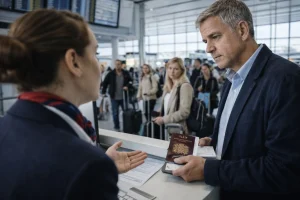
Even when travel insurance does not cover war-related disruptions, travellers may still have certain consumer rights under UK regulations.
Package holidays, for example, are subject to consumer protection rules that require tour operators to take responsibility when extraordinary circumstances prevent travel.
If a conflict makes a destination unsafe or inaccessible, tour operators may cancel the trip and provide a refund. Airlines also have obligations when flights are cancelled. Passengers are usually entitled to either a refund or a replacement flight.
However, compensation payments for delays or cancellations may not apply when disruptions are caused by extraordinary events such as war.
This distinction is important because travellers may receive refunds without additional compensation.
Real-Life Scenario: How Conflict Can Affect Travel Plans?
Consider a traveller from the United Kingdom who books a holiday several months in advance. At the time of booking, the destination is considered safe and no travel warnings are in place.
Several weeks before departure, tensions escalate and a military conflict begins in the region. News coverage increases and the UK government eventually advises against travel.
Airlines respond by cancelling flights, and the tour operator suspends holiday packages to the area.
In this situation, the traveller may receive a refund from the airline or the tour operator. However, their travel insurance policy may not provide compensation for the disruption if the policy includes a war exclusion clause.
This scenario illustrates why travellers should understand how insurance policies handle geopolitical events.
Confirmed Facts, Policy Discussions, and Common Misunderstandings
During times of global uncertainty, information about travel insurance can become confusing. Separating facts from speculation helps travellers make better decisions.
Confirmed Facts
Most travel insurance policies exclude losses directly caused by war or armed conflict. Government travel advice can influence whether insurance coverage remains valid, and airlines or tour operators may provide refunds when major disruptions occur.
Policy Discussions
Within the insurance industry, discussions occasionally arise about expanding coverage for certain geopolitical disruptions. However, such changes have not been widely implemented in standard policies.
Common Misunderstandings
A frequent misconception is that travel insurance automatically covers all travel disruptions. Another common belief is that insurance providers must refund cancelled trips caused by war.
In reality, these situations are usually handled by airlines, tour operators, or consumer protection laws rather than by insurance claims.
The 2026 Traveller’s Crisis Checklist
If a conflict begins while you are preparing to travel or are already abroad, follow these three steps in order. Note: Your airline is your first port of call, not your insurer.
- Step 1: Check the FCDO Status. Visit the official FCDO travel advice page. If the status has changed to “Advice against all travel,” your rights to a refund from a tour operator are much stronger.
- Step 2: Contact Your Airline or Tour Operator. Under UK 261 regulations, if an airline cancels your flight, even due to war or airspace closures, they are legally required to offer you a full refund or a reroute. They are your “first line of defence” for getting your money back.
- Step 3: Audit “Section 9: Exclusions” Open your insurance policy PDF and search for “Section 9” or “General Exclusions.” Look specifically for the terms “Hostilities,” “Invasion,” or “Act of War.” This will tell you exactly what your insurer will (and won’t) pay for once the airline’s obligations end.
Conclusion: Does Travel Insurance Cover War for UK Travellers?
The question “Does travel insurance cover war?” has become increasingly relevant as global conflicts affect travel plans more frequently.
For most travellers, the key point is that standard travel insurance policies generally exclude war-related events. While insurance may still cover unrelated medical emergencies or assistance for travellers already abroad, disruptions directly caused by war are usually outside policy coverage.
Travellers planning international trips during periods of geopolitical tension should take several practical steps. Reviewing government travel advice, understanding policy exclusions, and monitoring developments before departure can all help travellers make informed decisions.
In an era when global events can change quickly, being aware of how travel insurance works can provide clarity and reduce unexpected financial risks.
Frequently Asked Questions
Can travel insurance cover evacuation from a conflict area?
Some policies include emergency evacuation coverage, but the scope of this protection varies significantly. In many cases, evacuation benefits apply only before a conflict escalates into full-scale war.
Does travel insurance cover cancelled holidays caused by war?
Most policies exclude war-related cancellations. Refunds for cancelled holidays are more commonly provided by airlines or tour operators.
What happens if war begins while a traveller is already abroad?
Insurance policies may still cover certain services, such as medical emergencies or assistance, but losses directly related to war may not be reimbursed.
Are airlines responsible for refunds if flights are cancelled because of war?
Airlines typically provide refunds or alternative flights if services are cancelled. However, compensation payments may not apply because war is classified as an extraordinary circumstance.
Can travellers buy insurance after a conflict starts?
Insurance policies usually exclude events that are already known or ongoing at the time the policy is purchased.
Does terrorism fall under the same exclusion as war?
Not always. Many travel insurance policies provide limited terrorism coverage if the event occurs unexpectedly in a previously safe destination.
Does ignoring government travel advice affect insurance claims?
Yes. If travellers ignore official advice warning against travel, insurers may reject claims related to that trip.