
Getting the first 100 customers is one of the most important milestones for a new startup. At this stage, the business usually has limited brand recognition, a small marketing budget and little or no customer data to guide its decisions.
The good news is that startups do not need thousands of website visitors or a large advertising campaign to find their first customers.
Early growth normally comes from identifying a specific customer problem, speaking directly with potential buyers and using a handful of acquisition channels consistently.
For founders wondering how to get your first 100 customers as a startup, the focus should be less on rapid scale and more on learning who genuinely needs the product, why they are willing to pay for it and how the business can repeatedly reach similar people.
What Are the Most Effective Ways to Find Your First 100 Startup Customers?

Understand Exactly Who the First Customer Should Be
A common startup mistake is defining the target audience too broadly.
A business selling project management software, for example, may initially describe its audience as “small businesses“. That could include millions of organisations with completely different requirements.
A more useful early customer profile might be:
UK digital marketing agencies with 5–20 employees that currently manage client projects through spreadsheets and email.
This narrower definition immediately makes customer acquisition easier. The founder knows which companies to approach, which problems to discuss and where potential customers are likely to spend their time.
The first 100 customers do not necessarily need to represent the company’s eventual market. They simply need to represent a group experiencing a problem strongly enough to try a new solution.
Speak to Potential Customers Before Trying to Sell
Early customer conversations can provide information that analytics cannot.
Founders should speak directly with people who fit their ideal customer profile and ask about their existing problems, processes and frustrations.
Instead of immediately explaining the product, useful questions include:
- What is currently the hardest part of this process?
- How is the problem being handled today?
- How much time or money does it cost?
- Which existing solutions have already been tried?
- What would make someone consider switching?
- Who makes the purchasing decision?
Patterns will usually begin appearing after several conversations.
Those patterns can then influence everything from the product itself to pricing, website messaging and marketing.
Startup founders can also follow publications such as UK Business Journals to keep track of broader business, entrepreneurship and market developments that may affect how potential customers operate.
Start With the Founder’s Existing Network
The fastest path to the first few customers is often already available.
Founders can begin with previous colleagues, professional contacts, LinkedIn connections, suppliers, university networks, industry contacts and people they have met through previous businesses.
The objective is not to pressure friends into purchasing something they do not need. Instead, founders should identify people within their network who genuinely match the target customer profile.
Even when a contact is not a suitable buyer, they may know someone who is.
A simple introduction from a trusted person can carry significantly more credibility than an unsolicited advertisement from an unknown company.
Use Direct Outreach to Find Early Customers
Direct outreach is particularly effective during the earliest stage of a startup because it allows founders to target specific prospects rather than waiting for people to discover the company.
For B2B startups, this may involve:
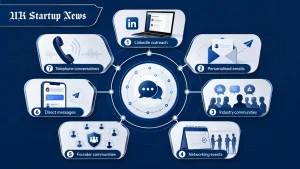
- LinkedIn outreach
- Personalised emails
- Industry communities
- Networking events
- Founder communities
- Direct messages
- Telephone conversations
The important word is personalised.
Sending thousands of generic messages is unlikely to provide useful feedback. A founder may achieve better results by carefully selecting 50 potential customers and writing messages specifically related to their businesses.
For example, rather than saying:
“We have developed innovative software that helps businesses improve productivity.”
A startup could explain the particular problem it noticed and why its solution may be relevant to that company.
Early-stage sales should feel more like problem-solving than mass marketing.
Create an Irresistible Early-Customer Offer
People naturally perceive greater risk when purchasing from an unfamiliar startup.
The company has little history, few reviews and possibly an evolving product. Founders therefore need to reduce the perceived risk of becoming an early customer.
Depending on the business model, an introductory offer could include:
- Free trials
- Founder pricing
- Free onboarding
- Extended guarantees
- Free consultations
- Early access
- Lifetime discounts
- Additional features
- Flexible cancellation
Discounting should not become the only reason customers buy.
The goal is to make it easier for someone who already sees value in the product to take the first step.
Make the First Customers Feel Like Partners
The earliest customers can contribute far more than revenue.
They can help identify product weaknesses, explain confusing features, suggest improvements and reveal why people decide to purchase.
Founders should create direct communication channels with these customers.
Instead of relying only on automated surveys, businesses can arrange occasional calls or personally ask customers about their experiences.
Questions such as “What nearly stopped you from buying?” can be particularly useful.
The answer may reveal problems with pricing, website messaging, onboarding or product functionality.
Companies can use these insights to improve the experience before attempting to acquire hundreds or thousands of additional users.
Build a Simple Referral System
Once customers are receiving genuine value, referrals can become one of the lowest-cost acquisition channels available.
Customers could be encouraged to recommend the startup to colleagues, friends or other businesses.
Referral incentives might include account credits, discounts, additional features or rewards. However, incentives are not always necessary.
Sometimes simply asking satisfied customers for an introduction is enough.
For example:
“Do you know two other businesses that have the same problem?”
For an early-stage founder, a personal introduction to a highly relevant prospect can be significantly more valuable than hundreds of untargeted website visits.
Create Content Around Customer Problems
Content marketing can gradually create another source of customers.
Instead of publishing generic industry articles, startups should create content addressing specific questions potential customers ask before making a purchase.
This might include:
- How-to guides
- Comparison articles
- Case studies
- Industry research
- Templates
- Calculators
- Checklists
- Product demonstrations
Search optimisation should support this strategy.
Google’s SEO Starter Guide provides guidance on helping search engines understand and discover website content.
A startup selling accounting software to freelancers, for example, could publish practical guides around invoicing, bookkeeping, allowable expenses and financial organisation.
Someone discovering the company through a useful article may eventually become a customer.
Participate in Communities Where Customers Already Gather
Startups do not always need to create an audience from scratch.
Potential customers are already participating in LinkedIn groups, Reddit communities, Slack groups, Facebook groups, professional associations, industry forums and offline networking organisations.
Founders should become useful members of relevant communities rather than immediately promoting their products.
Answering questions, providing insight and sharing genuinely useful resources can establish credibility.
When someone subsequently needs the type of product or service the startup provides, the founder or company may already be familiar to them.
Use Partnerships to Borrow an Existing Audience
Partnerships can dramatically accelerate early customer acquisition.
A startup should identify organisations serving the same customers without directly competing with its product.
For example, an HR software startup might partner with:
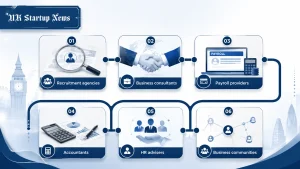
- Recruitment agencies
- Business consultants
- Payroll providers
- Accountants
- HR advisers
- Business communities
Each partner already has access to potential customers.
The startup can potentially arrange webinars, joint content, referral agreements, newsletter features or bundled services.
Instead of spending months building an audience, the startup receives exposure to an existing one.
Attend Relevant Events
Physical events remain valuable when customers are concentrated within a particular industry.
Trade exhibitions, startup meetups, local business events and conferences allow founders to speak directly with potential customers.
The objective should not necessarily be immediate sales.
A founder who has 20 meaningful conversations at an industry event may discover recurring problems that dramatically improve the company’s positioning.
The UK Government’s business support resources can also help founders identify available business guidance and support.
Turn Every Success Into Social Proof
Customer trust becomes easier to build once a startup can demonstrate that other people are already achieving results.
After several successful customers, founders should begin collecting:
Testimonials
Short statements explaining what customers liked about the product.
Case studies
More detailed examples showing the customer’s original problem, the solution implemented and the outcome.
Reviews
Independent customer reviews can help reduce purchasing uncertainty.
Customer logos
For B2B businesses, displaying recognisable customer brands can provide additional credibility where permission has been obtained.
Social proof should be specific whenever possible.
“Great product” is less persuasive than a customer explaining exactly what problem the product solved.
Track Where Every Customer Comes From
Even with only 20 customers, acquisition data can reveal important patterns.
A simple spreadsheet or CRM can record:
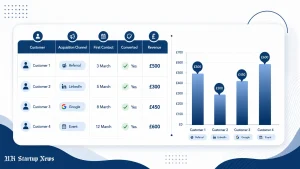
| Customer | Acquisition Channel | First Contact | Converted | Revenue |
| Customer 1 | Referral | 3 March | Yes | £500 |
| Customer 2 | 5 March | Yes | £300 | |
| Customer 3 | 8 March | Yes | £450 | |
| Customer 4 | Event | 12 March | Yes | £600 |
After several weeks, one channel may clearly outperform the others.
If referrals are generating 40% of customers while paid advertising produces almost none, the startup can put additional resources into referrals.
Early customer acquisition should therefore be treated as a series of experiments rather than a fixed marketing plan.
Do Things That Will Not Scale
Many founders immediately search for automated growth systems.
Automation becomes useful later.
During the first 100 customers, manual work can actually be an advantage.
A founder might personally:
- Onboard every customer
- Conduct product demonstrations
- Answer support questions
- Send personalised emails
- Collect feedback
- Help customers configure the product
- Follow up after purchases
These activities would become impossible with 100,000 customers.
With 20 customers, however, they provide an extraordinary amount of information.
Direct interaction helps founders understand exactly what customers value before the business begins automating its processes.
What Should Startups Avoid When Looking for Their First Customers?

One of the biggest mistakes is attempting too many marketing channels simultaneously.
A startup with limited resources may struggle if it tries Google Ads, Facebook Ads, TikTok, SEO, LinkedIn, events, cold email, influencer marketing and affiliate marketing at the same time.
There will not be enough data or attention to understand what actually works.
Instead, founders can choose two or three channels that closely match customer behaviour.
Another mistake is scaling advertising before confirming that customers actually value the product.
Paying to attract hundreds of visitors to an offer that does not convert simply accelerates the loss of money.
Validation should come before aggressive scaling.
How Long Does It Take to Get the First 100 Customers?

There is no universal timeframe.
A low-cost consumer app could potentially attract 100 users within days, while a B2B startup selling £50,000 enterprise contracts might take considerably longer to secure 100 paying organisations.
A more useful measure is whether the customer acquisition process is becoming increasingly predictable.
Founders should be able to answer questions such as:
- Which customers convert most frequently?
- Where are they being found?
- Why are they buying?
- How much does acquisition cost?
- How long does conversion take?
- Why do prospects reject the offer?
Once those answers become clearer, customer acquisition becomes easier to scale.
Final Thoughts
Learning how to get your first 100 customers as a startup is fundamentally about getting close to the market.
The first customers rarely come from sophisticated marketing funnels. They are more likely to come from founder outreach, professional networks, referrals, communities, partnerships and highly targeted content.
Those first 100 customers provide something even more valuable than early revenue: evidence.
They reveal who wants the product, what they are prepared to pay for, which messages persuade them and which acquisition channels deserve further investment.
Rather than trying to look like a large company from day one, startups can use their small size as an advantage. Speaking personally with customers, responding quickly to feedback and adapting the product rapidly can create the foundation for a repeatable growth strategy.
Once that foundation exists, scaling becomes far easier.